
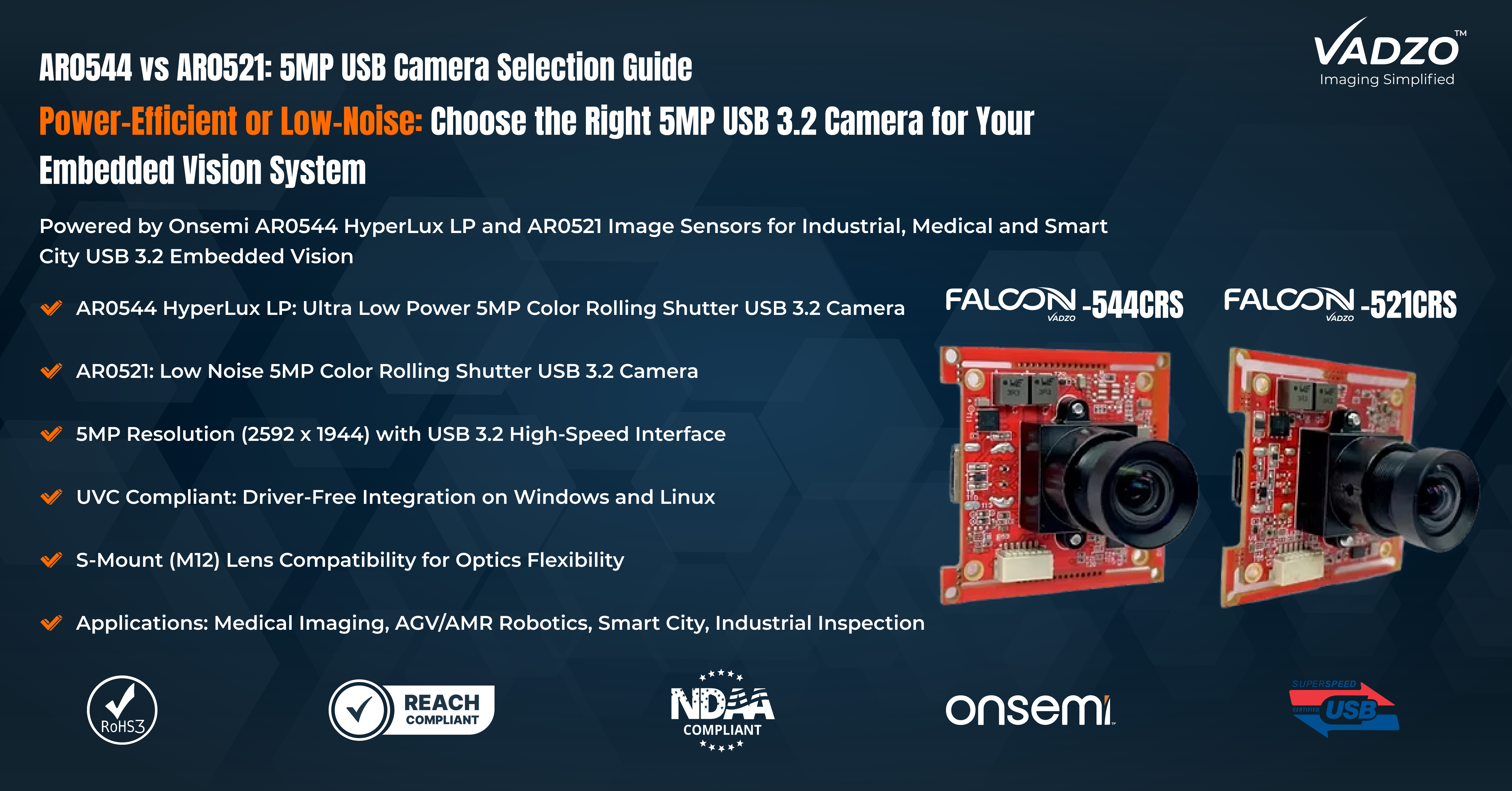
Vadzo Imaging’s Falcon-544CRS and Falcon-521CRS are both 5MP color rolling shutter USB 3.2 camera products built on Onsemi image sensors that address fundamentally different embedded vision design requirements. The Falcon-544CRS is powered by the AR0544 HyperLux LP sensor engineered for ultra-low power consumption in battery-constrained and thermal-budget-limited platforms. The Falcon-521CRS is powered by the AR0521 sensor designed for low read noise and higher per-pixel sensitivity from its larger 1/2.5″ optical format. This selection guide explains the sensor-level engineering trade-offs between the two to help OEM engineers, system integrators and embedded vision developers select the right 5MP USB camera for their specific application.
IRVINE, CA / ACCESS Newswire / July 3, 2026 / Vadzo Imaging, a provider of embedded vision camera products, today presents a technical selection guide for the Falcon-544CRS and Falcon-521CRS: two 5MP USB camera products within its Falcon USB 3.2 series that solve different imaging engineering problems. The Falcon-544CRS integrates the Onsemi AR0544 HyperLux LP image sensor and targets deployments where power budget and thermal constraints govern sensor selection. The Falcon-521CRS integrates the Onsemi AR0521 image sensor and targets applications where noise floor and per-pixel light collection determine imaging system performance. For embedded vision developers evaluating a 5MP USB 3.2 industrial camera, this guide provides a technical comparison of both sensors and their suitability across medical imaging, industrial automation, and smart city applications.
Sensor Architecture and Camera Overview
Selecting between a power-efficient 5MP camera and a high-sensitivity USB 3.2 camera within the same resolution class requires understanding what drives sensor architecture decisions beyond the headline megapixel number. The AR0544 and AR0521 share the same output resolution at 5MP (2592 x 1944) and the same USB 3.2 interface on the Falcon platform, but they are engineered around fundamentally different design priorities.
The AR0544 belongs to Onsemi’s HyperLux LP family. HyperLux LP is a sensor architecture platform that Onsemi engineered specifically to reduce power draw without sacrificing image quality at 5MP resolution. The 1/4″ optical format and 1.4 µm pixel pitch of the AR0544 allow the sensor die to remain compact, which directly contributes to lower active and standby power draw. For embedded vision applications deployed on AGVs, autonomous mobile robots, UAV payloads, and battery-operated edge nodes, the AR0544’s power envelope is a primary design advantage over sensors with larger die areas. The Falcon-544CRS brings this Onsemi HyperLux LP USB camera specification into a production-ready board-level module with USB 3.2 connectivity and UVC compliance for driver-free integration across Windows and Linux platforms.
The AR0521 addresses the opposite end of the design trade-off. Its 1/2.5″ optical format and 2.2 µm pixel pitch give each photodiode a larger collection area compared to the AR0544. Larger pixel area translates directly to greater photon capture per exposure cycle, which reduces the contribution of read noise relative to signal. For a low-noise 5MP USB camera, the AR0521’s pixel architecture delivers measurably improved signal-to-noise ratio in scenes with challenging illumination, including surgical lighting gradients, fundus imaging illumination profiles, digital pathology illumination conditions, and low contrast surface features in semiconductor and PCB inspection applications. The Falcon-521CRS packages the AR0521 into the same S-Mount compatible USB 3.2 form factor as the Falcon-544CRS.
Key specs: Falcon-544CRS | 5MP (2592 x 1944) | Onsemi AR0544 HyperLux LP | 1/4.2″ Optical Format | 1.4 µm Pixel Pitch | Rolling Shutter | Color | USB 3.2 Gen1 Type C Interface Backward Compatible to USB 2.0 | S-Mount (M12) | UVC Compliant, RoHS 3, REACH
Key specs: Falcon-521CRS | 5MP (2592 x 1944) | Onsemi AR0521 | 1/2.5″ Optical Format | 2.2 µm Pixel Pitch | Rolling Shutter | Color | USB 3.2 Gen1 Type C Interface Backward Compatible to USB 2.0 | S-Mount (M12) | UVC Compliant, RoHS 3, REACH
Product Specifications: AR0544 vs AR0521
|
Specification |
AR0544 (Falcon-544CRS) |
AR0521 (Falcon-521CRS) |
|
Sensor |
Onsemi AR0544 HyperLux LP |
Onsemi AR0521 |
|
Resolution |
5MP (2592 × 1944) |
5MP (2592 x 1944) |
|
Optical Format |
1/4.2″ |
1/2.5″ |
|
Pixel Size |
1.4 µm × 1.4 µm |
2.2 µm x 2.2 µm |
|
Shutter Type |
Rolling Shutter |
Rolling Shutter |
|
Chroma |
Color |
Color |
|
Embedded HDR |
Yes |
No |
|
Interface |
USB 3.2 Gen1 Type C Interface Backward Compatible to USB 2.0 |
USB 3.2 Gen1 Type C Interface Backward Compatible to USB 2.0 |
|
Compliance |
UVC, RoHS 3, REACH |
UVC, RoHS 3, REACH |
|
OS Support |
Windows, Linux, Android |
Windows, Linux, Android |
|
Operating Temperature |
−30°C to +85°C |
−30°C to +85°C |
Key Capabilities of the Falcon-544CRS and Falcon-521CRS: AR0544 vs AR0521 5MP USB Camera Comparison
Power Consumption and Thermal Budget in Embedded Vision Deployment: For system integrators designing battery-powered platforms such as AGVs, AMRs, and mobile inspection systems, the AR0544’s HyperLux LP architecture directly reduces runtime power draw compared to sensors in the same resolution class with larger die areas. In a deployed vision system, sensor power contributes to overall platform heat generation, which affects SoC thermal management, fan sizing, enclosure design, and battery runtime calculations. An AR0544 low-power USB camera operating at lower active power reduces the thermal load on the host system, which matters in sealed enclosures where passive cooling governs total system power budget. For developers evaluating low-power 5MP USB camera options for mobile robotics and automation and robotics deployments, the AR0544 platform offers a measurable advantage over the AR0521 in applications where minimizing power draw is a first-order design requirement.
Pixel Size, Noise Floor, and Low Light Imaging Performance: The AR0521’s 2.2 µm pixel pitch gives it a fundamental photon collection advantage over the AR0544’s 1.4 µm pixel pitch at equal exposure time and illumination levels. In quantitative imaging applications such as digital pathology, where tissue staining intensity must be measured accurately across the field of view, or in fundus imaging, where retinal vessel contrast is captured under controlled illumination, the sensor noise floor sets the lower limit of detectable signal variation. A low-noise 5MP USB camera built on the AR0521 will produce images with a higher effective dynamic range in these demanding applications compared to a camera product based on a smaller pixel sensor at the same resolution. For machine vision professionals evaluating automated optical inspection systems for PCB inspection or semiconductor inspection, the AR0521’s noise characteristics translate to better discrimination of fine surface features at low contrast without requiring increased illumination intensity.
UVC Compliance and USB 3.2 Bandwidth for Driver-Free OEM Integration: Both the Falcon-544CRS and the Falcon-521CRS connect over USB 3.2 with UVC compliance, which means they enumerate on Windows and Linux without custom driver development or third-party middleware installation. USB 3.2 bandwidth provides sufficient throughput for 5MP color streaming at practical frame rates without compression artifacts that reduce image fidelity for inspection tasks. For OEM developers integrating a 5MP rolling shutter USB camera into a host system that already runs a Windows or Linux environment, UVC compliance eliminates the driver porting timeline from the integration schedule. This is relevant for medical device platforms, smart city edge nodes, and industrial inspection systems where engineering resources are allocated to the imaging application pipeline rather than camera driver infrastructure.
“The AR0544 and AR0521 address two different but equally important problems in embedded vision design. When our customers come to us asking about a 5MP USB camera for an AGV or an AMR platform, the conversation quickly shifts to power budget and thermal ceiling. The AR0544 HyperLux LP sensor is built for exactly that constraint. When the conversation is about digital pathology or surgical imaging, the requirement shifts to noise floor and per-pixel sensitivity, which is where the AR0521’s larger pixel pitch becomes the decisive factor. Both products share the same USB 3.2 interface and S-Mount lens compatibility, so the selection comes down entirely to which sensor architecture best matches the system-level requirement.” – Alwin Vincent, Product Manager, Vadzo Imaging.
Applications
Medical Imaging: Digital Pathology, Surgical, and Fundus Imaging: In medical imaging workflows, image fidelity is a diagnostic and regulatory requirement rather than a quality preference. Digital pathology systems capture high-resolution images of histological slides at defined magnifications, where color accuracy, low noise, and uniform sensitivity across the imaging field determine whether the resulting image supports accurate diagnostic interpretation. The Falcon-521CRS and its AR0521 low noise image sensor address these requirements with a lower noise floor and greater per-pixel light collection than smaller-pixel alternatives at 5MP. For surgical imaging applications, including endoscopic visualization and intraoperative field monitoring where ambient illumination is tightly controlled, and image clarity is essential, the AR0521’s signal-to-noise characteristics support reliable visual output under surgical lighting conditions. Fundus imaging systems that capture retinal vessel and disc images operate under defined illumination constraints where sensor sensitivity directly determines image quality. Vadzo Imaging’s medical device and patient care application support extends to evaluation assistance for teams integrating the Falcon-521CRS into regulated medical imaging platforms.
Automation and Robotics: AGV Vision, AMR Navigation, and PCB Inspection: In factory automation and warehouse robotics deployments, the Falcon-544CRS and Falcon-521CRS serve distinct roles within the same operational environment. AGVs and AMRs that navigate autonomously using monocular or stereo vision pipelines require camera solutions where power consumption directly affects vehicle battery runtime and mission duration. The AR0544 low-power USB camera addresses this requirement with its HyperLux LP architecture, which reduces sensor power draw in continuous operation. During AGV navigation tasks, the imaging system runs continuously at operational frame rates, making cumulative power draw a significant factor in vehicle design. For fixed inspection stations performing PCB inspection or automated optical inspection, where power is not a constraint but image quality determines yield measurement accuracy, the AR0521’s larger pixel pitch produces imagery with greater sensitivity and lower background noise. Both products support the full range of automation and robotics applications within Vadzo’s embedded vision camera portfolio.
Smart City and Traffic Monitoring Infrastructure: Smart city infrastructure deployments present both power-constrained and imaging-quality-constrained use cases within the same deployment network. Pole-mounted or embedded edge nodes that run on solar power or limited grid capacity benefit from the AR0544’s low power characteristics, which reduce total system power draw in always-on monitoring configurations. Fixed intersection monitoring or license plate reading installations where AC power is available, and imaging performance under nighttime or low-visibility conditions matters more than power consumption, may favor the AR0521’s noise characteristics for improved low-light image quality. For teams deploying distributed sensor networks across smart city solutions infrastructure, Vadzo Imaging offers evaluation guidance to help engineers select the appropriate 5MP color USB camera based on site-level power availability, illumination conditions, and target image quality metrics.
Semiconductor and Industrial Inspection: Semiconductor inspection and wafer metrology applications require imaging systems that can resolve sub-pixel features on polished silicon surfaces with controlled illumination and minimal sensor-introduced noise. In these applications, read noise directly limits the detectability of low-contrast defects such as micro-scratches, contamination particles, and etch non-uniformity. The Falcon-521CRS and its AR0521 low-noise embedded vision camera architecture serve these requirements with a lower noise floor than smaller-pixel sensors at equivalent exposure conditions. For automated optical inspection systems where fine trace geometry and solder joint integrity are evaluated under bright-field and dark-field illumination, the AR0521’s pixel architecture provides the sensitivity needed to distinguish defect signatures from background variation. The 5MP resolution of both sensor platforms provides sufficient spatial sampling for sub-millimeter feature detection in precision manufacturing inspection contexts.
Frequently Asked Questions
Q: What is the fundamental difference between an AR0544 and an AR0521 5MP USB camera for embedded vision?
A: The AR0544 and AR0521 differ primarily in pixel architecture and the engineering priorities that result from that difference. The AR0544 is part of Onsemi’s HyperLux LP platform with a 1.4 µm pixel pitch and 1/4″ optical format engineered for low power consumption. It is best suited for applications where battery runtime, thermal budget, or power availability constrain the imaging system design, such as AGV navigation, AMR vision, and UAV payloads. The AR0521 has a 2.2 µm pixel pitch and 1/2.5″ optical format, which gives each pixel a larger light collection area, resulting in a lower noise floor and better low-light sensitivity. It suits applications where image fidelity, noise-limited detection, and per-pixel signal quality determine system performance, such as digital pathology, fundus imaging, and semiconductor inspection. Vadzo Imaging’s Falcon-544CRS is built on the AR0544, and the Falcon-521CRS is built on the AR0521, giving engineers direct access to both sensor architectures in a USB 3.2 production-ready camera module with identical S-Mount (M12) lens compatibility.
Q: Which 5MP USB 3.2 camera is better suited for a battery-powered AGV or AMR robotics platform?
A: For battery-powered platforms such as AGVs, AMRs, and mobile inspection robots, the Falcon-544CRS is the recommended option. The AR0544 HyperLux LP sensor’s low power architecture reduces active power consumption during continuous vision operation, which directly extends mission duration on a fixed battery capacity. In mobile robotics systems where the vision system shares a battery with drive motors, onboard compute, and actuators, every reduction in sensor power extends vehicle operational time and reduces the recharge frequency per shift. Vadzo Imaging designed the Falcon-544CRS for exactly these deployment scenarios where power budget is a primary system-level constraint alongside image quality requirements. The Falcon-544CRS delivers full 5MP color output at 2592 x 1944 over USB 3.2 with UVC compliance for driver-free integration on Linux-based robotic platforms. For teams evaluating low-power 5MP USB camera options for AGV navigation, obstacle detection, barcode reading, and AMR vision pipelines, the Falcon-544CRS provides a practical production-ready solution with the HyperLux LP power advantage.
Q: Does Vadzo Imaging provide evaluation kits and OEM integration support for the 5MP USB camera products?
A: Yes. Vadzo Imaging provides evaluation kits for both the Falcon-544CRS and Falcon-521CRS with no minimum order quantity requirement. Evaluation kits include the camera module with an S-Mount lens adapter and full documentation. Vadzo Imaging’s engineering team provides direct technical integration support for OEM teams evaluating the camera products for specific applications, including PCB inspection, fundus imaging, surgical visualization, and smart city edge deployments. Both products support UVC-compliant USB 3.2 operation on Windows and Linux without custom driver development. For teams with platform-specific integration requirements or firmware customization needs, Vadzo Imaging’s engineering team works directly through the integration process. Customization options include board form factor modifications, lens mount configuration changes, firmware customization for region-of-interest configuration, and frame rate control. To request an evaluation kit or discuss OEM integration requirements, contact Vadzo Imaging at support@vadzoimaging.com.
Q: Can a 5MP USB camera with rolling shutter handle industrial inspection tasks effectively?
A: Rolling shutter sensors, including both the AR0544 and AR0521, read pixel rows sequentially rather than simultaneously. In applications where the subject or camera is stationary or moves slowly relative to the exposure duration, rolling shutter produces geometrically accurate images without motion artifact. For stationary inspection tasks such as PCB inspection, semiconductor wafer inspection, and digital pathology slide scanning, where the object does not move during exposure, rolling shutter sensors operate effectively and deliver the full benefit of the sensor’s sensitivity and resolution specifications. In environments where parts move continuously on a conveyor or machinery operates at high speed during image capture, rolling shutter distortion may corrupt geometric measurements. For such cases, Vadzo Imaging offers global shutter USB camera options within its USB camera portfolio. Engineers evaluating which shutter architecture fits their inspection use case can contact Vadzo Imaging for application-specific guidance on sensor selection.
Q: How does Vadzo Imaging’s 5MP USB camera portfolio support OEM product development at different volumes?
A: Vadzo Imaging actively supports OEM product development across its entire 5MP USB camera portfolio, including both the Falcon-544CRS and Falcon-521CRS. There are no minimum order quantity restrictions for evaluation procurement, allowing development teams to begin integration with a single unit. For production-stage projects, Vadzo Imaging supports both low-volume prototype builds and high-volume manufacturing schedules. Hardware customization services include board size reduction from the standard 38mm x 38mm form factor to smaller footprints, custom lens mount configurations, and firmware modifications for application-specific feature sets. For medical device manufacturers that require RoHS 3 and REACH-compliant components, Vadzo Imaging confirms compliance across its camera portfolio. For industrial OEMs requiring extended temperature operation or ruggedized enclosure designs, Vadzo Imaging’s engineering team provides customization scoping and development support. Contact Vadzo Imaging at support@vadzoimaging.com to begin an OEM qualification discussion.
Availability
The AR0544 5MP USB camera (Falcon-544CRS) and the AR0521 low noise USB 3.2 camera (Falcon-521CRS) are both available now for evaluation and production orders. Visit the Falcon-544CRS product page or the Falcon-521CRS product page on the Vadzo Imaging website to review full specifications and request an evaluation kit. Contact Vadzo Imaging at support@vadzoimaging.com to discuss OEM integration requirements or volume pricing.
About Vadzo Imaging
Vadzo Imaging is a global provider of embedded vision solutions delivering high-performance camera technologies and imaging platforms for applications in robotics, industrial automation, UAVs, edge AI, and medical systems. Its camera products are designed for seamless integration with leading embedded platforms, including NVIDIA Jetson, Raspberry Pi, Qualcomm RB series, and NXP i.MX. Vadzo supports customers through hardware customization, firmware development, and its Vadzo NXT SDK, enabling faster development and deployment of vision-based systems. Visit www.vadzoimaging.com.
Media Contact
Alwin Vincent
Vadzo Imaging
Email: alwin@vadzoimaging.com
LinkedIn: Vadzo Imaging
YouTube: Vadzo Imaging
X: Vadzo Imaging
SOURCE: Vadzo Imaging
View the original press release on ACCESS Newswire


