NEW YORK, NY, UNITED STATES, June 24, 2026 /EINPresswire.com/ —
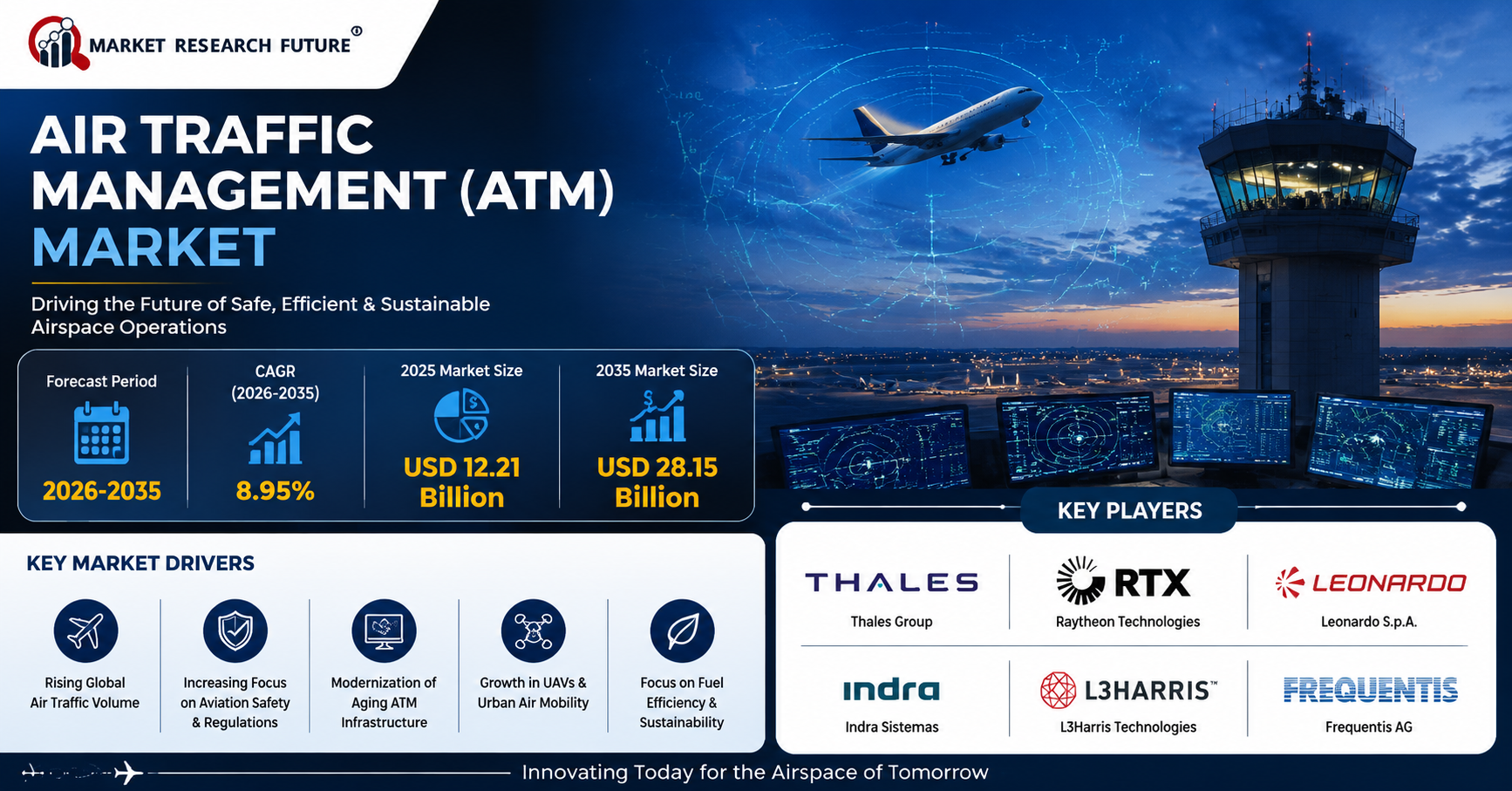
The global Air Traffic Management (ATM) Market is witnessing a strong transformation driven by rising global air traffic demand, rapid digitalization of aviation infrastructure, and the increasing need for safe, efficient, and sustainable airspace operations. According to recent industry analysis, the market is valued at USD 12.21 billion in 2025 and is projected to reach USD 28.15 billion by 2035, expanding at a robust CAGR of 8.95% during 2026–2035 .
The ATM ecosystem plays a critical role in ensuring seamless coordination of aircraft movements across global airspace through surveillance, communication, navigation, and traffic flow optimization systems. Increasing congestion in commercial aviation routes, coupled with the emergence of unmanned aerial vehicles (UAVs) and urban air mobility (UAM), is accelerating the need for next-generation ATM infrastructure.
The market encompasses hardware systems, software platforms, and services deployed across civil aviation, military aviation, and emerging drone-based air mobility operations.
Latest Market Trends:
1. NextGen and SESAR Modernization Programs – Global ATM modernization initiatives such as FAA’s NextGen and Europe’s SESAR are reshaping traditional radar-based systems into satellite-enabled, trajectory-based operations. These programs focus on improving airspace efficiency, reducing delays, and enhancing fuel efficiency.
2. Artificial Intelligence and Automation in ATM – AI-driven decision support systems are increasingly being deployed for predictive trajectory modeling, conflict detection, and traffic optimization. Machine learning algorithms are significantly improving controller efficiency and reducing operational workload.
3. Expansion of Unmanned Traffic Management (UTM) – The rapid growth of drones for commercial delivery, surveillance, and urban mobility is driving the development of dedicated UTM frameworks. This is creating entirely new airspace management layers.
4. Digital and Remote Tower Adoption – Airports are increasingly adopting digital tower solutions, enabling remote monitoring and control of air traffic operations. This reduces infrastructure costs while improving operational flexibility.
5. Satellite-Based Navigation and Surveillance – Global navigation satellite systems (GNSS) and ADS-B technologies are replacing traditional radar systems, enabling more accurate and continuous aircraft tracking.
Request Sample PDF of Report: https://www.marketresearchfuture.com/sample_request/6775
Market Drivers:
1. Rising Global Air Traffic Volume – The post-pandemic recovery in aviation has led to a surge in passenger traffic, significantly increasing demand for advanced ATM systems to manage airspace congestion efficiently.
2. Increasing Focus on Aviation Safety – Regulatory authorities such as ICAO and FAA are enforcing stringent safety mandates, requiring airlines and air navigation service providers to adopt advanced surveillance and automation technologies.
3. Modernization of Aging ATM Infrastructure – Many countries are upgrading legacy radar-based systems to digital and satellite-enabled platforms to improve accuracy, reliability, and scalability.
4. Growth in UAV and Urban Air Mobility – The increasing integration of drones and air taxis into civilian airspace is creating new demand for UTM systems and integrated airspace management platforms.
5. Fuel Efficiency and Environmental Sustainability Goals – ATM systems are being optimized to reduce flight delays, optimize routes, and minimize carbon emissions, supporting global sustainability initiatives.
Market Opportunities:
1. Expansion of AI-Enabled Predictive Air Traffic Systems
A major growth avenue in the Air Traffic Management (ATM) Market lies in the adoption of artificial intelligence-based predictive systems. These solutions enable real-time forecasting of air traffic congestion, weather disruptions, and potential airspace conflicts. By enhancing decision-making accuracy for air traffic controllers, AI-based ATM platforms significantly improve operational efficiency, reduce delays, and optimize flight paths. As aviation networks become more complex, the demand for intelligent automation tools is expected to accelerate.
2. Rapid Growth of Unmanned Traffic Management (UTM) Ecosystems
The increasing commercialization of drones and autonomous aerial vehicles is creating a strong opportunity for dedicated UTM infrastructure. Governments and aviation authorities are actively developing regulatory frameworks to integrate UAVs into controlled airspace. This is driving demand for scalable, cloud-based UTM platforms capable of handling high-density drone operations in urban and industrial environments, especially for logistics, surveillance, and infrastructure monitoring applications.
3. Digital Transformation of Airport and Airspace Operations
Airports worldwide are undergoing large-scale digital transformation initiatives, including the deployment of digital towers, remote air traffic control systems, and integrated surveillance platforms. This shift is opening opportunities for vendors offering end-to-end digital ATM ecosystems that combine communication, navigation, and surveillance into unified platforms. The transition from legacy systems to fully digital architectures is expected to remain a long-term growth driver.
4. Strong Demand from Emerging Aviation Markets
Emerging economies, particularly in Asia-Pacific, the Middle East, and parts of Latin America, are investing heavily in new airport construction and airspace modernization programs. These regions present significant opportunities for ATM solution providers due to rising passenger traffic, expanding airline networks, and government-backed aviation infrastructure projects. The need for scalable and cost-efficient ATM systems is particularly high in these fast-developing markets.
5. Integration of 5G, Satellite Networks, and Advanced Connectivity
The integration of 5G communication networks and next-generation satellite systems is expected to unlock new opportunities in real-time data exchange between aircraft and ground control systems. Enhanced connectivity enables more precise tracking, faster response times, and improved coordination across global airspace. This technological evolution is paving the way for highly connected, cloud-based ATM ecosystems that support both manned and unmanned aviation operations.
Segment Analysis:
1. By Domain
Air Traffic Control (ATC) dominates the market, accounting for approximately 50.80% share in 2025, driven by surveillance modernization and control tower upgrades.
Air Traffic Flow & Capacity Management (ATFCM) plays a crucial role in reducing congestion and optimizing airspace usage.
Aeronautical Information Management (AIM) is expected to grow steadily due to increasing digital data exchange requirements.
Unmanned Traffic Management (UTM) is the fastest-growing segment due to rising drone deployment.
2. By Component
Hardware holds the largest share at around 67.90% in 2025, driven by radar systems, ADS-B stations, and surveillance infrastructure.
Software is growing rapidly with a strong CAGR above 9%, supported by AI-based analytics and automation tools.
Services are expanding due to increasing demand for system integration, maintenance, and managed ATM solutions.
3. By Application
Communication systems remain the backbone of ATM operations.
Navigation systems are transitioning toward satellite-based frameworks.
Surveillance systems are increasingly dependent on ADS-B and multilateration technologies.
Automation & decision support systems are gaining traction due to AI integration.
4. By End Use
Commercial Aviation dominates due to increasing passenger traffic.
Military/Defense Aviation relies on secure and advanced surveillance systems.
Urban Air Mobility & Drone Operators represent the fastest-growing end-use segment, driven by emerging UAV applications.
Regional Analysis:
North America – North America leads the global ATM market with approximately 34.50% revenue share in 2025, supported by strong FAA NextGen investments and advanced aviation infrastructure. The region remains a pioneer in ATM digital transformation.
Europe – Europe holds a significant share, driven by SESAR initiatives and cross-border airspace integration programs. The region is actively investing in sustainable aviation and digital tower technologies.
Asia-Pacific – Asia-Pacific is the fastest-growing region with a CAGR of 9.50%, fueled by rapid air traffic expansion in China and India and increasing airport infrastructure development.
Middle East & Africa – The region is witnessing steady growth driven by aviation hub expansion in countries like the UAE and Saudi Arabia.
Latin America – Gradual modernization of aviation infrastructure is supporting moderate growth in ATM adoption.
Recent Developments:
June 2026: Indra Sistemas expanded its AI-powered ATM platform capabilities, enhancing predictive traffic management solutions for European airspace operators.
March 2026: Frequentis AG introduced next-generation digital tower enhancements aimed at improving remote air traffic control efficiency.
November 2025: Raytheon Technologies announced upgrades to its integrated surveillance systems supporting NextGen ATM modernization initiatives.
August 2025: Thales Group advanced its satellite-based ATM solutions to support global trajectory-based operations.
May 2025: Saab AB expanded its air traffic management portfolio, focusing on unmanned traffic integration systems.
Competitive Landscape and Key Companies
The ATM market is highly competitive and technology-driven, with leading players focusing on AI integration, system modernization, and global expansion.
Key companies include:
Thales Group (France)
Thales is one of the world’s foremost ATM technology providers, offering an expansive portfolio that spans ATC automation systems, surveillance solutions, communication platforms, and simulation tools. The company’s deep expertise in systems integration and its established relationships with ANSPs across Europe, Asia Pacific, and the Middle East position it as a primary beneficiary of ongoing modernization programmes. Thales continues to invest heavily in R&D, particularly in AI-enhanced ATC platforms and digital tower solutions.
Raytheon Technologies (United States)
Raytheon Technologies brings unparalleled scale and systems engineering capability to the ATM market through its Raytheon Intelligence & Space division. The company is a key contractor for FAA infrastructure programmes and maintains a strong presence in radar, surveillance, and communication systems for both civil and military airspace management. Its advanced sensor technologies and integration expertise enable comprehensive ATM solution delivery across complex environments.
Leonardo S.p.A. (Italy)
Leonardo occupies a significant position in the global ATM market, with particular strength in radar systems, communication technologies, and ATC simulation. The company serves a broad customer base across Europe, Africa, and Asia, and has made notable investments in digital ATM platforms and remotely operated tower solutions. Leonardo’s strategic focus on innovative airspace management technologies positions it well for the market’s continued evolution.
Indra Sistemas (Spain)
Indra Sistemas is a global leader in ATM, offering end-to-end solutions encompassing ATC automation, surveillance systems, simulation platforms, integrated resource management tools, and decision-support systems. The company’s ATENEA ATC system is deployed across more than 40 countries, demonstrating its formidable international footprint. Indra’s strategic partnerships — most recently with SITA — and its active M&A strategy amplify its innovation capacity and market reach.
Frequentis (Austria)
Frequentis specializes in communications and information technology for safety-critical control rooms, with a particularly strong ATM focus. The company’s voice communication systems and controller working position technologies are deployed in hundreds of control centers globally. Its recent AI-driven ATM solution launch underscores its commitment to incorporating advanced analytics into safety-critical controller support environments.
Conclusion:
The global Air Traffic Management (ATM) Market is entering a transformative phase driven by increasing air traffic demand, technological innovation, and the integration of autonomous aerial systems. With strong investments in AI, satellite navigation, and unmanned traffic management, the market is expected to evolve into a highly digitized, data-driven ecosystem.
By 2035, ATM systems will play a critical role not only in traditional aviation but also in managing drones, air taxis, and next-generation aerial mobility platforms, making it one of the most strategically important sectors in global aviation infrastructure.
Browse More Reports:
Air Traffic Market
https://www.marketresearchfuture.com/reports/air-traffic-market-33794
Air Traffic Control Equipment Market
https://www.marketresearchfuture.com/reports/air-traffic-control-equipment-market-7037
Air Traffic Control Simulation Training Market
https://www.marketresearchfuture.com/reports/air-traffic-control-simulation-training-market-8033
Sagar Kadam
Market Research Future
+1 628-258-0071
sales@marketresearchfuture.com
Legal Disclaimer:
EIN Presswire provides this news content “as is” without warranty of any kind. We do not accept any responsibility or liability
for the accuracy, content, images, videos, licenses, completeness, legality, or reliability of the information contained in this
article. If you have any complaints or copyright issues related to this article, kindly contact the author above.

Media gallery